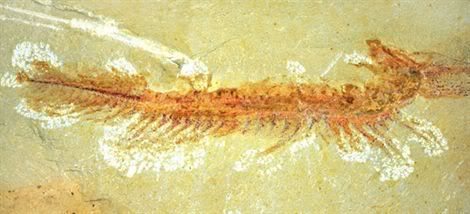
Mysteries and revelations of a discovery of marine fossils nearly 600 million years old fossils of algae
. (Image: Zhe Chen) last 600 million years before the rampant evolution of diverse life forms known as the Cambrian Explosion, a community of marine algae and animals like worms lived in a quiet area at depth under the sea, near the present Lantian, a small town in the province of Anhui, South China. After his death, left about 3,000 fossils almost immaculate, conserved among the beds of black shale deposited in water devoid of oxygen.
A team of scientists from the China Academy of Sciences, USA Virginia Tech, and Northwestern University in Sian, China, presented the results of its first analysis of recently discovered fossils and realize the mystery surrounding them.
addition to algae and potential protogusanos old, the fossil biota Lantian, named for its location, includes macrofossils structures with complex and confusing. In total, scientists have identified about 15 different species in the paleontological site.
The fossils suggest that morphological Diversification No macroscopic eukaryotes (the first versions of organisms with complex cellular structures) could occur a few tens of millions of years after the alleged Period of Snowball Earth, the popular way of naming a hiperglacial period that is believed buried in ice on the planet makes between 726 and 635 million years ago. And his presence in the black shales, rich in organic matter, suggests that, despite the general lack of oxygen, did exist some unstable oxygen in the oceans.
Therefore, two questions arise: Why this community evolved into the place and when it did? There is a clear difference regarding the number of species compared with the biota preserved in older rocks. There are more species here and are more complex and larger than those that evolved earlier. These rocks were formed shortly after the most intense ice age, during which much of the oceans froze.
The research team suggests that the Lantian Basin was largely without oxygen, but had brief periods of oxygenation which were duly exploited by new and complex life forms that populated the area, until the oxygen and eventually disappeared again with their lives. Some of the specimens that died have been preserved as fossils today.
The investigation has been made Xunlai Yuan, Chuanming Zhou and Chen Zhe, China Academy of Sciences, Shuhai Xiao of Virginia Tech, and Hong Hua Northwestern University in Sian.


0 comments:
Post a Comment